
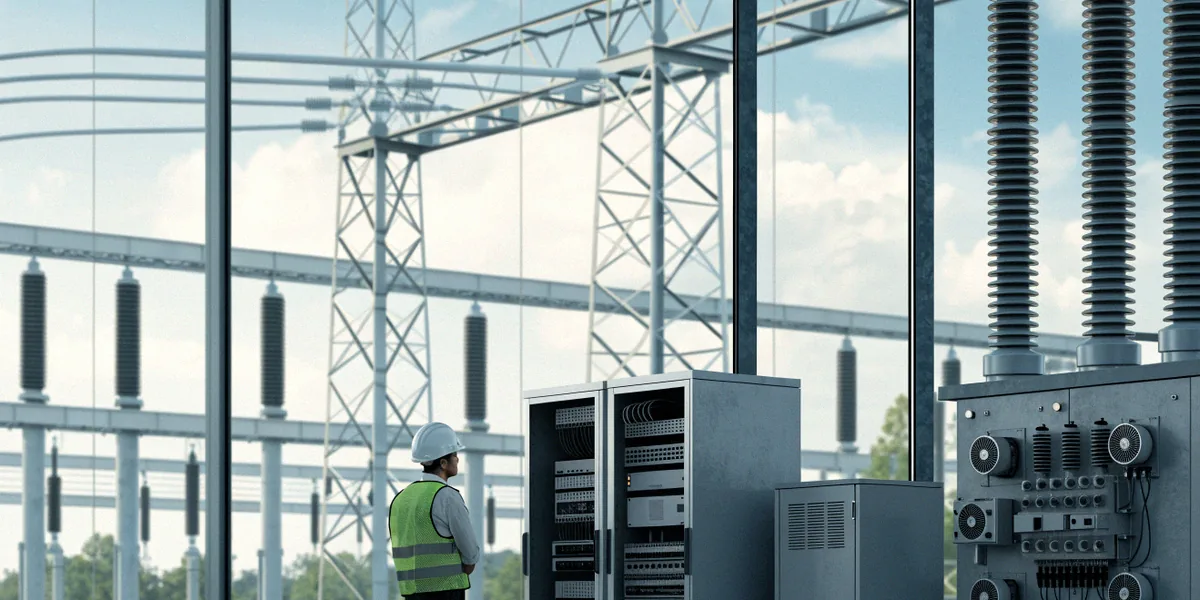
IEC 61850 Europe – Substation Automation and Smart Grid Standards
For years, IEC 61850 was the standard that everyone in the UK transmission and distribution world nodded along with at conferences, then quietly went back to their hardwired schemes and proprietary protocols. Net zero has changed that. When you are trying to connect offshore wind farms, interconnectors, battery storage and millions of electric vehicles to a grid that was designed around coal-fired generation, the old ways of doing things simply do not scale. The Viking Link interconnector alone carries 1,400 MW between the UK and Denmark, and its substations rely on IEC 61850 for automation. Multiply that across every new grid connection and reinforcement project in the country, and the case for a common digital language becomes impossible to ignore. That is why we started iec61850-europe.com – to give UK substation engineers, protection specialists and SCADA teams a place to read honest, technical, vendor-neutral analysis of what IEC 61850 actually delivers, where it falls short, and what it takes to make it work in the field.
Why IEC 61850 Matters for UK Substation Automation
The shift from hardwired copper to Ethernet-based communications is the single biggest change in substation design since the move from electromechanical to numeric relays. In a conventional substation, every trip signal, every current transformer connection and every status indication is a physical pair of wires running back to a marshalling kiosk and then into the control room. That approach works, but it is expensive to install, difficult to modify and almost impossible to diagnose when something goes wrong at three in the morning.
IEC 61850 replaces much of that copper with a structured Ethernet network carrying standardised data models. A merging unit digitises current and voltage at the source, publishes it on the process bus, and any intelligent electronic device (IED) that subscribes to that stream can use it. A protection relay detects a fault and publishes a GOOSE message that trips a circuit breaker somewhere else in the yard in a few milliseconds. A SCADA gateway reads the same data via MMS and reports it to the control centre. One physical network, many logical functions.
National Grid’s Viking Link interconnector is a useful illustration. This 765 km subsea cable links Bicker Fen in Lincolnshire with Revsing in Denmark, and the converter stations at both ends use IEC 61850-based substation automation to manage protection, control and monitoring. When you are coordinating protection across two national grids with different operating philosophies, having a standardised data model at the interface is not a luxury – it is a necessity.
Distribution network operators are following the same path. SSEN’s RIIO-ED2 innovation projects include digital substation trials built around GOOSE messaging, specifically to test whether the technology can reduce the physical footprint of new primary substations and shorten outage durations during commissioning. These are not laboratory exercises. They are real substations feeding real customers.
The headline benefits that keep coming up in every business case are consistent:
- Interoperability – devices from different manufacturers exchange data using a common model, rather than requiring bespoke protocol converters or gateways.
- Reduced commissioning time – fibre connections and configuration files replace thousands of individual copper terminations, and factory acceptance testing can be done against a simulated network before anyone sets foot on site.
- Lower lifetime cost – adding a new bay or a new function means adding a subscription, not pulling another multicore cable through a crowded trench.
- Better diagnostics – the network itself becomes a source of information, with every message timestamped and loggable.
None of this happens overnight, and we would be doing you a disservice if we pretended the transition was painless. But the direction of travel is clear, and the regulatory and commercial pressures are now strong enough that delaying adoption carries its own risk.
The Problem with Legacy Protocols (DNP3, Modbus)
DNP3 and Modbus have served the industry well for decades. They are simple, well understood and lightweight enough to run over serial links with minimal processing power. The trouble is that they were designed for a world of point-to-point telecontrol, not for the data-rich, high-speed, peer-to-peer environment of a modern digital substation.
Modbus is the more limited of the two. It has no native timestamping, no event buffering and no standard object model. A register holding a current measurement is just a number – there is no self-description, so every integration requires a manually maintained point list that inevitably drifts out of date. DNP3 is considerably better, with time-stamped events, unsolicited reporting and a degree of object typing, which is why it remains widespread in UK distribution telecontrol.
Neither protocol, however, was built for the job that GOOSE does. DNP3 over TCP simply cannot guarantee the sub-10 millisecond delivery that protection intertripping requires. You cannot use it to publish sampled values from a merging unit. And neither protocol carries a rich enough data model to describe the relationships between a circuit breaker, its associated current transformers, and the protection functions that operate on them.
In practice, most UK substations now run a hybrid model: IEC 61850 inside the substation fence, and DNP3 or IEC 60870-5-104 out to the control centre. That is a sensible approach and one we would generally recommend.
How IEC 61850 Solves Vendor Lock-In
Anyone who has spent time in a UK control room will have heard the same complaint: we cannot replace that relay because it is the only one that talks to the rest of the scheme. Vendor lock-in has been a genuine commercial problem for years, and it shows up in three ways.
First, spares and replacements. If your protection scheme was built around a proprietary peer-to-peer protocol, you cannot substitute a different manufacturer’s relay when the original reaches end of life without rebuilding the scheme.
Second, system expansion. Adding a bay to an existing substation often means buying more of the same equipment from the same supplier, regardless of whether it is the best technical or commercial choice.
Third, information access. Getting data out of a proprietary system and into an asset management platform frequently requires paid gateways and licence fees.
IEC 61850 addresses all three by standardising the data model, the services used to access it, and the configuration language that describes it. In theory, a protection engineer can swap out a relay from one manufacturer for a relay from another, update the substation configuration description (SCD) file, and the scheme continues to function. In practice the interoperability is not perfect – more on that later – but it is far better than the alternatives, and the commercial leverage it gives asset owners is significant.
UK Regulatory Drivers: RIIO-ED2 and Net Zero
The regulatory framework is doing as much to drive IEC 61850 adoption as any technical argument. RIIO-ED2, the price control that governs the six distribution network operators for the five years from 2023 to 2028, explicitly rewards innovation, flexibility and whole-system thinking. Digital substation trials feature in several DNO business plans because they offer a credible route to doing more with less physical infrastructure.
Ofgem’s expectation is that networks will demonstrate value for money, and that increasingly means avoiding the kind of gold-plated, copper-heavy designs that used to be the default. IEC 61850 supports that agenda by reducing materials, shortening outages and enabling more granular data collection.
At transmission level, the picture is similar. National Grid ESO’s ambition for a zero-carbon grid by 2025 and negative emissions thereafter requires a level of visibility and control that conventional substation automation cannot provide. Interconnectors, HVDC links and large offshore wind farms all need to be integrated into a common operating picture, and IEC 61850 is increasingly the lingua franca for doing so.
Cyber security regulation is the third leg of the stool. The NIS Regulations 2018 require operators of essential services – which includes much of the UK’s electricity network – to implement appropriate and proportionate security measures for their critical infrastructure. IEC 61850 networks are part of that critical infrastructure, and demonstrating compliance means being able to show that you have addressed their specific risks.
GOOSE and MMS: The Messaging Backbone of Digital Substations
Anyone getting to grips with IEC 61850 quickly encounters two acronyms that appear far more often than the rest: GOOSE and MMS. Understanding what each does, and where each belongs, is fundamental to designing a sensible digital substation.
GOOSE – Generic Object Oriented Substation Event – is the peer-to-peer messaging service used for time-critical signals. It is published on the station bus or process bus as an Ethernet multicast, and any device that subscribes to it receives the message directly without going through a server. The publisher repeats the message continuously, even when nothing has changed, so subscribers can detect a loss of communication immediately. This is what makes GOOSE suitable for protection tripping, interlocking and blocking schemes.
MMS – Manufacturing Message Specification – is a client-server protocol. It is used for reporting, control and configuration, and it is the service that SCADA gateways use to talk to IEDs. MMS is not time-critical in the same way; a report arriving 20 milliseconds later than expected is not a problem. But it is information-rich, supports spontaneous reporting and logging, and is the mechanism by which the bulk of operational data reaches the control centre.
SP Energy Networks deployed an IEC 61850-based process bus at its Wishaw substation as part of a project to test the technology in a live 275 kV environment. The scheme uses merging units to digitise conventional instrument transformers and publishes the resulting sampled values onto the process bus, with protection functions subscribing to those streams. The lessons learned there – particularly around testing, time synchronisation and fault investigation – have informed SP Energy Networks’ approach to subsequent digital substations.
At National Grid’s Hinkley Connection Project, IEC 61850 is part of the automation architecture supporting the new 400 kV and 132 kV infrastructure that connects Hinkley Point C to the wider network. The scale of the project, which involves significant new substation construction and reinforcement across Somerset and the surrounding area, makes the standardised approach attractive from both a design and a commissioning perspective.
GOOSE Performance: 3ms vs 10ms Tripping
The performance figures for GOOSE get quoted a lot, and it is worth being precise about what they mean. IEC 61850 defines performance classes for different types of message, and the two that matter most for protection are commonly referred to as P3 and P6.
A P3 class message should be delivered within 3 milliseconds of the event – this is the class used for the most demanding applications, such as direct intertripping between protection relays in a busbar scheme. A P6 class message allows up to 10 milliseconds, which is adequate for many distribution protection applications and for signals that are not on the critical path.
In practice, the network design determines what you can achieve. A well-engineered, lightly loaded 100 Mbit/s or 1 Gbit/s Ethernet network with priority tagging (IEEE 802.1Q) and no unnecessary traffic can comfortably meet the 3 millisecond target. A congested network with poorly managed multicast filtering will not, and this is where a lot of early digital substation projects came unstuck. The lesson we would emphasise is that a digital substation lives or dies by its network design. Treat the communications network as a protection system in its own right, not an IT afterthought.
MMS for SCADA Integration
If GOOSE is the nervous system, MMS is the reporting layer. It is what allows a SCADA system to see the state of every breaker, every measurement and every alarm in the substation, using standardised object references rather than a bespoke point database.
The practical benefit is significant. In a conventional substation, integrating a new IED into SCADA means building a point list, mapping each signal to a SCADA database entry, and testing it end to end. The same process in an IEC 61850 substation can be largely automated: the IED’s capabilities are described in its configuration file, the SCD file describes what it publishes, and the SCADA gateway can import that model directly.
That is the theory. In reality, most UK SCADA systems are not yet fully model-driven, and there is still a manual step in mapping IEC 61850 data objects to the operational database. But the mapping is at least unambiguous and machine-readable, which reduces the scope for error and makes future changes far less painful.
Sampled Values (SV) and Merging Units
Sampled Values, usually abbreviated to SV, is the IEC 61850 service that carries digitised current and voltage waveforms from a merging unit to the devices that need them. A merging unit takes the analogue output of a conventional current transformer or a non-conventional optical sensor, samples it at typically 80 samples per cycle for protection, and publishes those samples as an Ethernet multicast.
The appeal is obvious. Once current and voltage are on the network, you can subscribe as many devices as you like to the same stream. You can eliminate the ratiogrouping and wiring errors that plague conventional schemes. You can replace copper with fibre, which also provides galvanic isolation as a bonus. And with non-conventional instrument transformers – optical CTs and low-power VTs – you can reduce the physical size of the switchgear and remove the risk of dangerous open-circuit CT secondary conditions.
The catch is that SV streams are bandwidth-heavy. A single merging unit publishing 80 samples per cycle of four voltages and four currents generates a substantial amount of traffic, and the network has to be sized accordingly. Time synchronisation also becomes critical: if the merging unit and the protection relay disagree about when a sample was taken, differential protection will see spurious currents. This is why IEC 61850-9-2 networks typically use IEEE 1588 Precision Time Protocol with hardware timestamping, often backed up by a GPS-derived grandmaster clock.
Building a Digital Substation: Practical Lessons from the UK
We have been involved in or close to enough digital substation projects to know that the technology works. We have also seen enough projects run late and over budget to know that success depends far more on design discipline and testing rigour than on the choice of equipment. The following sections reflect the lessons we would pass on to any UK team planning a digital substation.
Process Bus vs Station Bus Design
The distinction between the station bus and the process bus is one of the first things to get straight in a digital substation design.
The station bus connects IEDs within the control room and to the SCADA gateway. It carries GOOSE messages for interlocking and protection signalling between bays, and MMS traffic for reporting and control. It is generally a redundant, managed Ethernet network, often using parallel redundancy protocol (PRP) or high-availability seamless redundancy (HSR) to provide resilience.
The process bus extends the network out into the switchyard, connecting merging units and intelligent circuit breakers to the protection and control devices. It carries Sampled Values and, in some architectures, GOOSE for trip signals to intelligent breaker controllers.
The choice of architecture matters because it affects everything from cable routing to testing strategy. A fully distributed process bus, where every bay has its own merging unit and protection devices subscribe over the network, offers the greatest flexibility and the smallest copper footprint. A more conservative approach, where the process bus is limited to the most demanding applications and conventional wiring is retained elsewhere, is easier to justify in the early stages of a digital substation programme.
Most UK projects we have seen have taken a staged approach. SP Energy Networks’ Wishaw deployment, for instance, focused the process bus on selected bays rather than converting the entire substation at once. That is a sensible way to build confidence and refine the design before committing to a wider rollout.
UK suppliers have adapted their product lines accordingly. GE Grid Solutions, Siemens Energy and Hitachi Energy all offer IEC 61850 Edition 2 compliant IEDs with process bus interfaces, and all three have been involved in UK digital substation projects at transmission and distribution level. The competition between them is healthy, and it is one of the reasons interoperability has improved markedly since the early Edition 1 days.
Cyber Security: IEC 62351 and NIS Regulations
Connecting protection and control devices to an Ethernet network creates a security surface that simply does not exist in a hardwired scheme. That is not a reason to avoid IEC 61850, but it is a reason to take cyber security seriously from the outset.
IEC 62351 is the standard that addresses the security of IEC 61850 and related protocols. It covers authentication, encryption, role-based access control, and security event logging. Not every part of IEC 62351 is widely implemented yet, and there is a practical tension between strong encryption and the millisecond latency budgets that GOOSE requires. Most implementations therefore rely on network segregation and access control for the time-critical traffic, applying cryptography where it fits.
The UK regulatory backdrop is the NIS Regulations 2018, which implement the EU’s Network and Information Systems Directive in UK law. Operators of essential services in the electricity sector must take appropriate technical and organisational measures to manage risks to their network and information systems, and must report significant incidents to the relevant competent authority – in this case, the Department for Energy Security and Net Zero, with Ofgem as the sector regulator. The NIS Regulations 2018 require cyber security measures for critical substation infrastructure, and IEC 61850 networks fall squarely within scope.
In practical terms, that means a digital substation design should include:
- A clearly defined security zone and conduit architecture, with IEC 62443 principles applied to the substation network.
- Strict control over which devices can join the process bus and station bus, using IEEE 802.1X port authentication where feasible.
- Logging of all configuration changes and security events, with retention periods that satisfy regulatory expectations.
- A patching and vulnerability management process that covers IEDs as well as conventional IT systems.
- Physical security for network cabinets and fibre patch panels, which are often overlooked.
We will be writing more about IEC 62351 implementation in later posts, because it is one of the areas where UK practice is still evolving and where there is genuine disagreement about the right balance between security and performance.
Testing and Commissioning with Omicron and Doble
Testing a digital substation is fundamentally different from testing a conventional one, and it is often the stage where projects come unstuck. The good news is that the test equipment has matured considerably.
Omicron’s CMC test sets with IEC 61850 capability allow engineers to inject Sampled Values directly onto the process bus and to subscribe to GOOSE messages, so a protection function can be tested end to end without any physical analogue injection. Doble’s protection test sets and software tools offer similar capabilities, and both vendors have invested heavily in supporting Edition 2 features such as flexible functional naming and multiple logical devices.
The practical challenges are more about process than equipment. Configuration management becomes critical: the SCD file is the single source of truth for the whole scheme, and an uncontrolled change to one IED’s configuration can break subscriptions across the network. We would strongly recommend version control, change control and a documented configuration baseline before commissioning begins.
Factory system testing, where the complete protection and control scheme is assembled and tested against simulated primary plant before shipping to site, pays for itself many times over. It is far easier to debug a GOOSE subscription problem in a factory than in a live substation during a limited outage window.
Smart Grid Standards Beyond IEC 61850: What Else UK Engineers Need
IEC 61850 is not the only standard in the smart grid toolkit, and no sensible engineer would try to use it for everything. There is a family of complementary standards that UK engineers need to be familiar with, and knowing when to use which is part of the skill.
IEC 61850 vs DNP3: When to Use Which
The short answer is that IEC 61850 belongs inside the substation, and DNP3 or IEC 60870-5-104 belongs on the wide-area telecontrol link between the substation and the control centre. But the longer answer is a bit more nuanced.
IEC 61850 is the right choice when:
- You need peer-to-peer communication between IEDs, particularly for protection.
- You need Sampled Values from merging units.
- You want a rich, self-describing data model that reduces integration effort.
- You are building or refurbishing a substation and can influence the whole design.
DNP3 or IEC 60870-5-104 is the right choice when:
- You are communicating over a bandwidth-constrained or high-latency link.
- You need to integrate with a legacy control centre that does not support IEC 61850 natively.
- You are dealing with a small number of points and do not need the full IEC 61850 model.
- You need proven, widely deployed telecontrol security features such as DNP3 Secure Authentication.
IEEE 1815 is the IEEE standard that formalises DNP3, and DNP3 Secure Authentication version 5 is widely used in UK distribution telecontrol. It is a mature, well-understood protocol, and there is no shame in using it where it fits.
CIM and IEC 61970 for Network Modelling
The Common Information Model, defined in IEC 61970 for transmission and IEC 61968 for distribution, provides a standard way to describe power system network models. Where IEC 61850 describes the devices in a substation, CIM describes the network those substations are part of – lines, transformers, generators, loads, and the topology that connects them.
The two standards are complementary, and there is active work on mapping between them. For UK engineers, the practical relevance of CIM is growing as network operators look to share models between planning, operations and market systems. National Grid ESO’s move towards a fully modelled, data-driven grid relies heavily on CIM-based information exchange, and the same is true of the distribution network operators’ transition to active network management.
The UK smart meter rollout, which has now passed tens of millions of installations, generates a huge volume of consumption data that feeds into forecasting and flexibility markets. Making sense of that data at scale requires standardised information models, and CIM is part of the answer.
Future-Proofing for Flexibility Markets
The UK’s flexibility markets – where distributed energy resources are paid to adjust their output or consumption to support the network – depend on being able to see and control assets at the edge of the grid. That means data from substations, from smart meters and from third-party aggregators all flowing into common platforms.
IEC 61850 has a role to play here at the substation level, particularly in providing real-time visibility of what is happening on the distribution network. But it is not sufficient on its own. The Energy Networks Association’s Open Networks project references IEC 61850 for interoperability as part of its work on standardising how distributed energy resources connect and communicate with network operators. The project is explicitly designed to reduce the cost and complexity of connecting flexible assets, and standardised substation data models are part of that picture.
The direction of travel is clear: increasingly, substations will be expected to publish data in standard formats, respond to standard control signals, and integrate with market platforms without bespoke engineering. IEC 61850 is one part of the standards stack that makes this possible, but it sits alongside CIM, OpenADR, IEEE 2030.5 and others. UK engineers who understand the whole stack will be in demand.
Our Editorial Promise: What You’ll Read on This Blog
We started iec61850-europe.com because we were tired of reading vendor white papers dressed up as technical analysis, and conference presentations that glossed over the difficult parts. Our mission is simple: to provide informed, honest opinion on IEC 61850 adoption in the UK, written by people who have actually commissioned substations and debugged GOOSE subscription problems at two in the morning.
That means we will tell you when a technology is not ready, when a vendor’s claims do not match our experience, and when a regulatory requirement is more about box-ticking than genuine engineering. It also means we will give credit where it is due, and highlight the projects and teams that are genuinely pushing the industry forward.
Who We Are and Why We Write
Our team is made up of protection and control engineers, SCADA specialists and substation designers who have spent their careers in the UK electricity industry. Between us we have worked on transmission substations, distribution networks, offshore wind connections and interconnector projects. We are not affiliated with any equipment vendor, and we do not accept sponsored content that compromises our editorial independence.
We write because we believe the UK’s smart grid transition is one of the most important engineering challenges of our generation, and because the quality of technical discussion around IEC 61850 in this country could be better. There is a great deal of practical knowledge locked up in individual engineers’ heads, and we want to help get some of it into the open.
How We Test and Verify Claims
Where we make technical claims, we try to ground them in one of three sources: our own direct project experience, published project documentation from UK network operators, or the standards themselves. When we quote performance figures – such as GOOSE transfer times or Sampled Values bandwidth – we are either reporting what we have measured or what the relevant standard specifies, and we will be clear about which.
Where we are expressing an opinion, we will say so. Where there is genuine uncertainty or disagreement in the industry, we will present both sides rather than pretending there is a single right answer. And when we get something wrong, we will correct it openly rather than quietly editing the original post.
Suggest a Topic or Share Your Project
This blog is better when it reflects the questions people are actually asking. If you are working on an IEC 61850 project and have hit a problem you cannot find written up anywhere, tell us about it. If you have commissioned a digital substation and learned something the hard way, we would like to hear from you. If you disagree with something we have written, we would especially like to hear from you.
Over the coming months we will be publishing posts on the Energy Networks Association’s Open Networks project and what it means for substation data models, detailed fault case studies from real UK digital substation incidents, comparisons of Edition 2 interoperability between major vendors, and practical guidance on IEC 62351 implementation. If there is something you would like us to cover, get in touch.
Frequently Asked Questions
Is IEC 61850 mandatory in the UK?
No. IEC 61850 is not mandated by law or by the grid codes for all substations in the UK. However, it is increasingly specified by transmission and distribution network operators for new build and major refurbishment projects, particularly at transmission level and on strategic distribution substations. National Grid’s Viking Link interconnector, SP Energy Networks’ Wishaw digital substation and SSEN’s RIIO-ED2 innovation trials all use IEC 61850, and the trend is towards wider adoption. For smaller or legacy distribution substations, DNP3 and IEC 60870-5-104 remain common.
What is the difference between GOOSE and MMS?
GOOSE is a peer-to-peer publish-subscribe protocol used for time-critical signals such as protection trips, interlocking and blocking schemes. It is carried directly on Ethernet as a multicast and typically achieves delivery times of 3 to 10 milliseconds. MMS is a client-server protocol used for reporting, control and configuration, carrying the bulk of operational data to SCADA. It is not time-critical in the same way. Both are part of the IEC 61850 standard, and a typical digital substation uses both.
Do I need IEC 61850 if I am only running a distribution substation?
Not necessarily. Many UK distribution substations continue to operate perfectly well with DNP3 or IEC 60870-5-104 telecontrol and conventional hardwired protection. The case for IEC 61850 becomes stronger when you need peer-to-peer communication between IEDs, when you are deploying process bus technology, or when you want to reduce the physical footprint of a new primary substation. SSEN’s RIIO-ED2 digital substation trials are specifically testing whether the technology delivers enough benefit at distribution level to justify wider rollout.
How does IEC 61850 relate to the NIS Regulations 2018?
The NIS Regulations 2018 require operators of essential services – including much of the UK electricity network – to implement appropriate cyber security measures for their critical infrastructure. IEC 61850 networks within substations are part of that critical infrastructure, so they fall within scope. IEC 62351 provides the security framework specifically for IEC 61850, covering authentication, access control and event logging. In practice, compliance means applying IEC 62443 zone and conduit principles, controlling network access, logging configuration changes and managing vulnerabilities across IEDs as well as IT systems.
What is the difference between the station bus and the process bus?
The station bus connects IEDs within the control room and to the SCADA gateway. It carries GOOSE messages between bays and MMS traffic for reporting and control. The process bus extends the network into the switchyard, connecting merging units and intelligent circuit breakers to protection and control devices, and carries Sampled Values plus, in some architectures, GOOSE trip signals. The process bus typically requires more careful attention to time synchronisation and bandwidth planning than the station bus.
IEC 61850 is not a silver bullet. It will not fix a poorly designed protection scheme, it will not compensate for inadequate testing, and it will not excuse a network architecture that has been thrown together without proper planning. What it does offer is a standardised, future-facing framework that allows UK substations to handle the complexity of a net-zero grid without drowning in copper and proprietary protocols. The transition is a journey rather than a destination, and every project teaches the industry something new. We would like this blog to be part of that conversation. If you are working on IEC 61850 in the UK – whether you are specifying it, designing it, commissioning it or troubleshooting it – we invite you to join in, share your experience, and help the whole industry move forward together.
Latest articles
- Winter Peak Demand and the Role of Digital Substations in the UK Grid
 Winter Peak Demand and the Role of Digital Substations in the UK Grid It is 5pm on a dark January evening. Somewhere…
- Time Synchronisation with PTP
 Time Synchronisation with PTP: Getting IEC 61850 Timing Right A few winters ago, we were called into a UK digital substation where…
- SCL Files: ICD, SCD and CID Demystified
 SCL Files: ICD, SCD and CID Demystified A junior engineer joins a UK digital substation project on a Monday morning, opens the…
- Sampled Values and the Process Bus
 Sampled Values and the Process Bus: The Backbone of Digital Substations Walk into a UK primary substation built in the 1980s and…
- Migrating a Legacy Substation
 Migrating a Legacy Substation to IEC 61850: What We Learned Most UK legacy substations were never designed for the digital substation era,…
- Interoperability Testing Between Vendors
 Interoperability Testing Between Vendors: Making IEC 61850 Work in the Real World We were on site at a UK digital substation project…